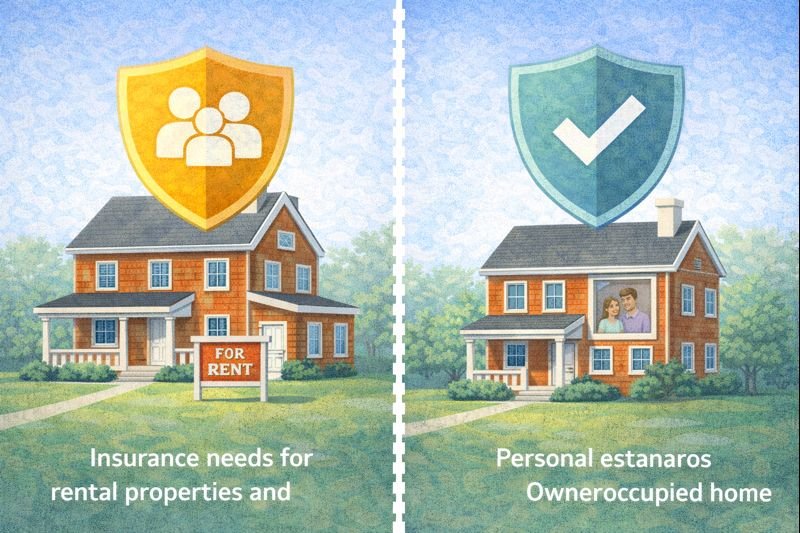
The most expensive mistake in rental property ownership costs about $300 a year: using a homeowners policy to insure a tenant-occupied home. The policy looks identical, the agent may not object, and nothing happens — until a fire, a liability suit or a burst pipe, when the occupancy clause does its quiet work and the claim collapses. This guide maps the real differences between landlord and homeowners insurance, gap by gap, with the dollar consequences attached.
The occupancy clause: where the products legally diverge
Homeowners insurance is priced and underwritten on one assumption: the owner lives in the home. The policy’s occupancy requirement is explicit — the residence must be owner-occupied for coverage to apply as written.
Move out and place tenants, and the property no longer matches the contract. Some carriers will non-renew when they discover it; others will accept the premium and wait. But at claim time, a material misrepresentation of occupancy gives the insurer grounds to reduce or deny the entire claim.
The discovery mechanisms are unglamorous and effective: the claim adjuster’s interview notes who answers the door, the lease agreement produced in discovery, utility records, and mail. Denials based on occupancy misrepresentation are routinely upheld in court because the misrepresentation is factual, not interpretive.
What landlord insurance adds that homeowners lacks
Loss of rents coverage: if a covered peril makes the unit uninhabitable, the policy pays the actual lost rent — commonly up to 12 months. A fire that displaces tenants for five months in a $1,800-a-month unit generates a $9,000 loss-of-rents payment that no homeowners policy would ever make.
Landlord-specific liability: tenant injuries from property conditions, and the legal defense that comes with them. Tenant liability claims are more frequent than fire claims by a wide margin — icy steps, faulty railings, mold complaints — and they are litigated against the property owner, not the tenant.
Optional structures for the rental business: ordinance or law coverage for rebuilding to current code, equipment breakdown for furnished units, and — critically — no coverage at all for tenant belongings, which is the landlord’s responsibility to disclose and the tenant’s to insure through renters insurance.
What homeowners covers that landlord policies drop
Personal property coverage inside the home largely disappears — landlord policies cover only owner-owned appliances and furnishings, not the general household contents coverage a residents’ policy carries.
Other-structures coverage changes character: detached garage or fence coverage remains, but the framing shifts to its income role, and some carriers reduce default sub-limits on rental dwellings.
Medical payments to guests works differently: a homeowners policy assumes guests of the owner; a landlord policy assumes tenants and their guests, which is exactly why the liability limits and defense coverage are built heavier.
| Coverage element | Homeowners policy | Landlord policy |
|---|---|---|
| Dwelling (owner-occupied) | Covered | Covered (tenant-occupied) |
| Occupancy requirement | Owner must live there | Tenancy is the assumed use |
| Loss of rents | Not covered | Up to 12 months actual rent |
| Tenant injury liability | Risky, occupancy-based denial | Built for it, with defense |
| Tenant belongings | Never covered | Never covered (renters insurance) |
| Owner’s contents in unit | Full personal property | Appliances/furnishings only |
| Typical annual premium (example) | $2,400 | $2,800–$3,000 |
The cost difference, and why it is smaller than the risk
Landlord policies typically run 15 to 25 percent more than equivalent homeowners coverage on the same dwelling — for a $2,400-a-year homeowners policy, expect $2,800 to $3,000 for landlord coverage with loss of rents.
That 20 percent premium buys the occupancy fix, the income protection, and the heavier liability construction. The denial risk from keeping a homeowners policy on a rental is effectively a 100 percent loss of premium value — you paid for a policy that will not pay.
Carriers also treat tenant-occupied homes more favorably than owners expect on some fronts: fewer personal-property theft claims, and some discount for professional property management.
The claims that expose the gap, concretely
Kitchen fire in a tenant-occupied home, homeowners policy: dwelling damage may be paid grudgingly under a pro-rata or misrepresentation theory; loss of rents denied entirely — four months at $1,800 is $7,200 gone; tenant’s burned belongings denied because they were never the owner’s insurable interest.
Tenant slips on unrepaired stairs, homeowners policy: personal liability section may deny on occupancy grounds, leaving the owner personally funding a defense and settlement that a landlord policy’s liability section would have absorbed.
Same events, landlord policy: dwelling rebuilt, rents paid monthly, tenant injuries defended and settled, tenant pointed to their own renters policy for belongings. The $300-a-year difference resolved into tens of thousands of dollars.
Switching mid-tenancy without a coverage gap
The transition is a two-day operation. Bind the landlord policy with an effective date, then cancel the homeowners policy the same day — never cancel first and shop second, because a one-day lapse creates a coverage gap question on every future application.
Notify your mortgage servicer if the home is financed: servicers monitor occupancy, and a documented transition to a landlord policy is a routine, expected event. Expect a possible escrow adjustment for the premium difference.
Require renters insurance in the lease at the same time. It is the cheapest mechanism to close the tenant-belongings gap and reduces your own liability exposure, since tenants with policies are measurably less likely to litigate small claims.
- Occupancy is a contract term, not a technicality — misrepresent it and claims collapse.
- Loss of rents is the single biggest financial gap between the two products.
- Tenant belongings are never the landlord policy’s job; require renters insurance.
- The premium difference is ~20%; the denial risk is total.
- Bind the new policy before canceling the old one — never create a lapse.
On a typical rental, the annual cost difference between landlord and homeowners coverage is about $300. The kitchen fire that tests the difference produces a $70,000 dwelling claim plus $7,000 in lost rents plus a tenant liability suit. Buy the policy that matches the actual use of the building.
Key takeaways
- A homeowners policy on a rental is a misrepresentation, not a savings.
- Loss of rents and tenant liability are the landlord policy’s core additions.
- Tenant property is never covered by either — renters insurance closes it.
- Landlord coverage costs 15–25% more; denial risk costs everything.
- Transition policies in the right order: bind first, cancel second.
Frequently asked questions
Can I use homeowners insurance on a rental property?
No. Homeowners policies require owner occupancy. Insuring a tenant-occupied home under one is a material misrepresentation that gives the insurer grounds to deny claims.
Why is landlord insurance more expensive?
It prices tenant occupancy: higher liability frequency, loss-of-rents exposure, and different usage patterns. The difference is typically 15–25% over homeowners coverage.
Does landlord insurance cover the tenant’s belongings?
No, under either product. Tenants need their own renters insurance, which landlords should require in the lease.
What is loss of rents coverage?
It reimburses the rent you do not collect while the property is uninhabitable after a covered peril — commonly up to 12 months of actual rent.
How do I switch from homeowners to landlord insurance?
Bind the landlord policy with an effective date first, then cancel the homeowners policy on the same date. Never allow a gap between the two.